
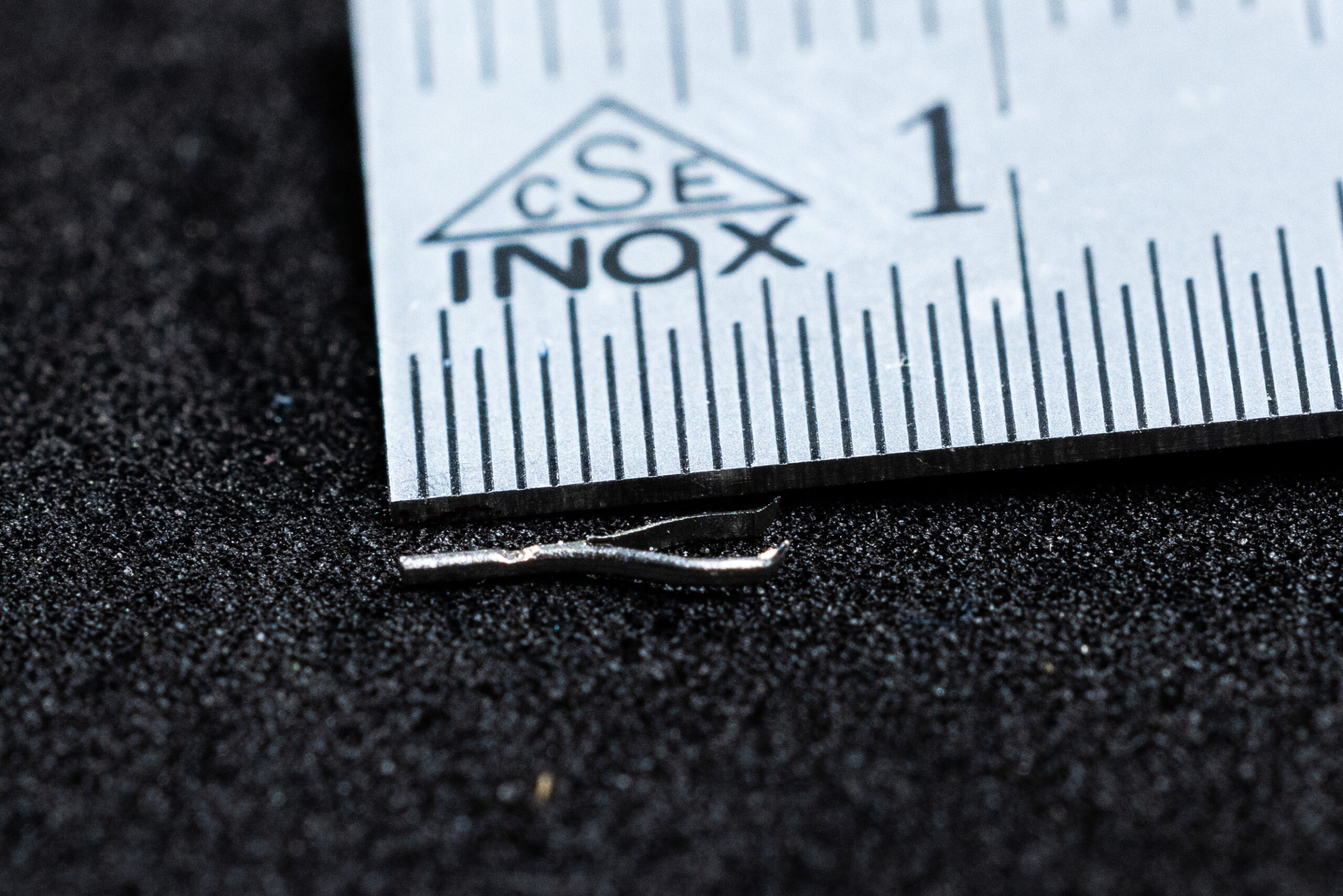
A micrometer (μm) is equal to 0.001 millimeters, or one-thousandth of a millimeter. In other words, 1 millimeter consists of 1,000 micrometers.
But just how small is a micrometer, really, and why do just a few micrometers play such a crucial role in precision manufacturing and microfabrication?
At Retero, we work with these dimensions every day: from micro-holes as small as 10μm to EDM wires with a diameter of Ø20 μm, right down to manufacturing tolerances of ±1 μm.
How small is 1 micrometer?
A micrometer is one-thousandth of a millimeter (0.001 mm).
But what does that mean in practice?
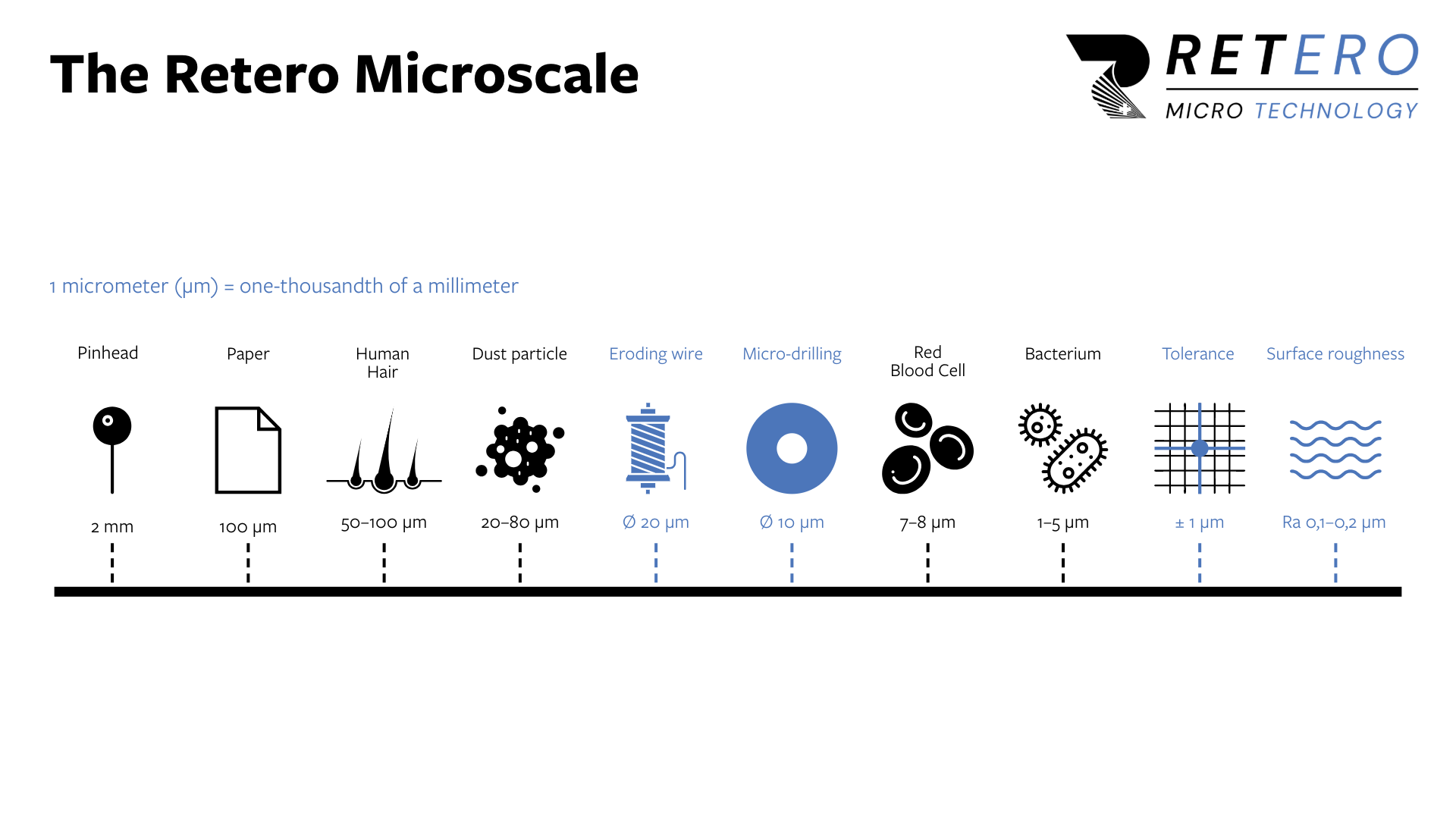
A sheet of paper is about 100 μm thick. A human hair measures 50 to 100 μm, depending on the person, while a particle of dust measures about 20 to 80 μm. A red blood cell has a diameter of just Ø7 to 8 μm, and many bacteria are even as small as 1 to 5 μm.
These comparisons vividly illustrate the scale at which microfabrication operates.
Microfabrication at Retero: Working in the Micrometer Range
In precision manufacturing, millimeters are often no longer sufficient as a unit of measurement. Micrometers are what matter.
Our thinnest EDM wires have a diameter of just Ø20 μm. That is less than half the diameter of many human hairs.
Using micro-EDM drilling, we produce micro-holes with diameters down to Ø10 µm. Such holes are barely visible to the naked eye.
Things get even more challenging when it comes to manufacturing tolerances.
A tolerance of ±1 μm means that a component may deviate by no more than one-thousandth of a millimeter from the specified target dimension.
This level of precision is critical to component functionality, quality, and manufacturing process reliability.
How big are 100 μm, 20 μm, 10 μm, and 1 μm?
It’s hard to visualize micrometers in everyday life. A thought experiment can help make the scale easier to understand.
Let’s imagine that 1 millimeter were enlarged to 1 meter.
Then the following would apply:
| Actual size | In a thought experiment |
| 100 μm | 10 cm |
| 20 μm | 2 cm |
| 10 μm | 1 cm |
| 1 μm | 1 mm |
What is barely visible in actual micro-manufacturing would suddenly become measurable and tangible in this world magnified a thousandfold.
This is precisely the scale at which Retero operates every day.
Why are micrometers so important in precision manufacturing?
Modern products are becoming smaller, more powerful, and more technically sophisticated. As a result, the demands on component geometry, surfaces,microstructures, and manufacturing tolerances are also increasing.
Precision in the micrometer range is particularly relevant in fields such as medical technology, the semiconductor industry, the watchmaking industry, tool and mold making, and aerospace.
In these fields, deviations of just a few micrometers can determine whether a component functions reliably.
Therefore, as structures become smaller, manufacturing, measurement metrology , and process control become increasingly demanding.
Which manufacturing processes enable micrometer-level precision?
Retero uses a variety of high-precision manufacturing technologies to produce the smallest components, contours, holes, and microstructures.
These include, among others, fine-wire EDM, micro-EDM drilling, micro-EDM milling,die-sinking EDM, and precision laser cutting.
These processes enable the machining of geometries and dimensions that are sometimes difficult or even impossible to achieve with conventional manufacturing methods.
It is not just a matter of producing particularly small components. What is crucial is the combination of microfabrication, repeatability, and the highest precision.
After all, in demanding applications, it is often no longer the millimeter that matters, but the micrometer.