EDM Drilling (Start hole EDM)

Start hole EDM: Precise, deep micro holes in the hardest materials.
A process that is ideal for micro-holes in materials that are difficult to machine and and for producing start holes for subsequent EDM operations.
With EDM drilling, we produce precise holes in electrically conductive materials where conventional drilling reaches its limits. The process is particularly suited for micro-holes smaller than Ø 0.1 mm or for start holes required for wire EDM. We achieve accurate deep holes in hardened steels, titanium, carbide, and other materials that are difficult to machine. Customers in medical device manufacturing, high-precision watchmaking, and tool and mold making already benefit from the exceptional accuracy of our micro-hole EDM capabilities.

We are certified to ISO 9001 and ISO 13485 (medical device certification) by the Swiss Association for Quality and Management Systems.
Advantages of EDM drilling / start hole EDM at a glance
Precise micro holes:
Your benefit: Accurate micro-holes for precision-critical applications.
Start hole for WireEDM:
Your benefits: Seamless process chain, maximum efficiency and precision in the production of complex internal contours.
Extreme ratio of depth to diameter:
Your benefit: Deep, precise holes where traditional drilling fails.
Process reliability from experienced specialists:
Your benefit: Reduced inspection effort, lower scrap rates, and greater process reliability.
Suitable for the hardest materials:
Your benefit: No limits on material hardness, we drill precisely in any electrically conductive material.
Collaborative Engineering Support:
Your benefit: Our experts are happy to help you optimize your components and processes.
Non-Contact Machining:
Your benefit: No burrs, no material deformation, and no change in microstructure.
Process integration with other technologies (Wire EDM, EDM sinking):
Your benefit: Less coordination effort, higher part quality, shorter lead times. And all with the highest Swiss quality.
What is EDM Drilling?
Here you will find answers to the most frequently asked questions about start-hole EDM. Find out more about the process, its advantages and possible applications as well as important technical details.
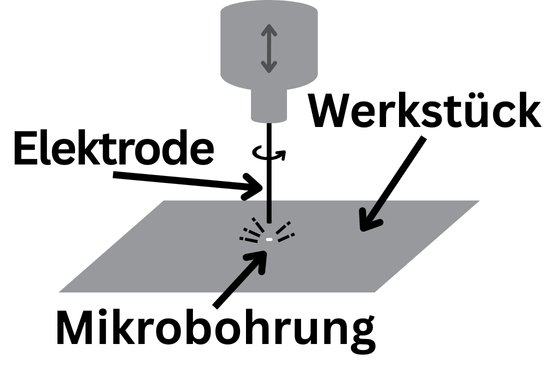
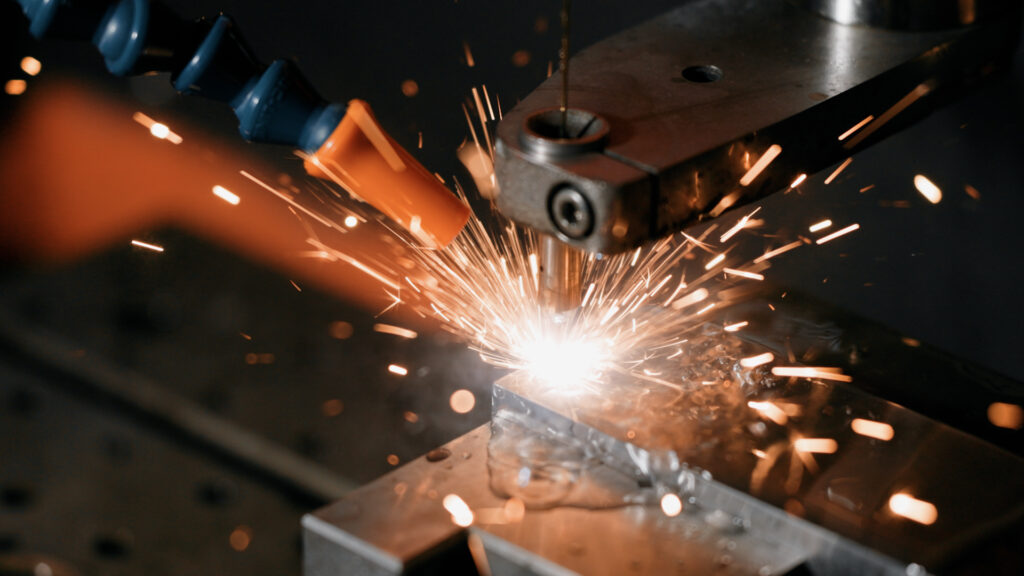
EDM Drilling is a precise process for creating small holes in electrically conductive materials. A rotating tubular electrode is fed into the workpiece. Controlled electrical discharges occur between the electrode and the material, removing material locally through spark erosion. The dielectric fluid (deionized water) flushes away the eroded particles and cools the process. The result is clean, burr-free micro holes smaller than Ø 0.1 mm (up to 2 mm deep) up to diameters of Ø 3 mm (up to 200 mm deep).
The material is removed without mechanical contact through a very high frequency of electrical discharges. As no mechanical force is applied to the workpiece, distortion and microstructural changes are avoided. The process is particularly suitable for machining hardened steels, carbide, titanium, medical-grade stainless steel, and other materials that are difficult to machine conventionally. Start Hole EDM is ideal for producing micro-holes, for generating start holes for wire EDM, and for the extraction of broken tools (e.g., taps) from components without damaging the workpiece.
Each discharge momentarily generates temperatures of up to 12,000 °C, which locally removes the material through vaporization. The resulting heat-affected zone is extremely narrow, with minimal thermal influence. In contrast to mechanical drilling, no burrs and no residual stresses are introduced into the workpiece. This process enables the creation of very small diameters (below Ø 0.1 mm) with high aspect ratios, which are not achievable using conventional drilling, where tools would quickly break due to load and wear.
Technical details for start hole EDM
- Micro-hole diameters: from < Ø 0.1 mm (up to 2 mm depth) to max. Ø 3 mm (up to 200 mm depth)
- Tolerances: up to ±0.02 mm (depending on material, wall thickness and hole diameter)
- Surface roughness: Paired with fine wire EDM down to Ra 0.08 / N3
- Electrode material: carbide / brass
- Maximum workpiece size (L × W × H): approx. 200 × 300 × 200 mm (depending on fixturing)
- Dielectric fluid: deionized water
- Production capability: single parts, prototypes, and series production
Materials that are suitable for EDM Drilling
– Medical-grade stainless steels: AISI 304, 316L (highly corrosion-resistant)
– Titanium and titanium alloys
– Carbides (e.g. tungsten carbide)
– High-performance tool steels and high-speed steels
(e.g. HSS, ASP, powder-metallurgical tool steels)
– Stainless steels (INOX), hardened steels up to > 60 HRC
– Aluminum, copper, brass, bronze
– Technical ceramics
– Special alloys: NiTi (Nitinol), Hastelloy
Typical applications of start hole erosion
Tool and mold making
- Micro-holes for ejector pins or conformal cooling channels in injection molds.
- Venting channels for air or gas in mold cavities.
Medical technology
- Formation of micro-fluidic and implant channels with high positional accuracy.
Aerospace Idustry
General Precision Engineering
We guarantee the highest accuracy and quality.
Why choose Retero as your partner for microdrilling?
Your idea deserves the highest precision.
When it comes down to the micrometer, every detail counts. As a family-run company, Retero GmbH is your experienced partner for high-precision micromachining. With over 20 years of specialization, a state-of-the-art machine fleet and Swiss quality, we deliver uncompromising results reliably and personally.
Swiss quality
Retero has been certified to ISO 9001 and ISO 13485 for more than ten years. Two internationally recognized standards that mean measurable safety and trust for our customers.
- ISO 9001 confirms our consistently implemented quality processes in all areas, from production to delivery.
-
ISO 13485 is the gold standard in medical technology and requires:
- complete traceability
- validated processes and suppliers
- strict documentation and uncompromising precision
Our quality assurance goes beyond standards: We embody genuine Swiss precision – driven by responsibility, technical excellence, and a clear commitment to safety.


What our customers say about us
Trustindex überprüft, ob die Originalquelle der Bewertung Google ist. Eine unkomplizierte Firma mit hohem Fachwissen, die Ihr Handwerk versteht. Nur zu empfehlen, tolle Zusammenarbeit.Gepostet aufTrustindex überprüft, ob die Originalquelle der Bewertung Google ist. Wie pflegen eine langjährige und gute Zusammenarbeit. Der Erodierspezialist schlechthin. spalinger präzisionsmechanik gmbhGepostet aufTrustindex überprüft, ob die Originalquelle der Bewertung Google ist. Microbearbeitungs Profi mit höchster Präzension. Sehr zu empfehlen!Gepostet aufTrustindex überprüft, ob die Originalquelle der Bewertung Google ist. Retero ist in der Mikrobearbeitung wie Feindraht- und Drahterodieren, Präzisionslaserschneiden sowie im Stanz- und Biegewerkzeugbau ein unschlagbar Partner. Die hohen Erwartungen an die Qualität der Werkstücke wird Retero in allen Belangen gerecht.
Questions and answers about
Start hole eroding
In brief: Start hole erosion is the process of creating precise start holes in hard materials using electrodes and erosion. Start-hole EDM is a fast and particularly economical method of metal processing for very thin to very thick materials. Thanks to the CNC control with electrode changer, it is possible to guarantee fast and precise processing of the materials. Appropriate electrodes are used depending on the area of application and the materials to be processed. The advantages are clear: more economical series processing, minimized sources of error, faster processes and high-precision results.
In brief: Metals such as steel, aluminum and copper as well as hard metals and composite materials. Start-hole EDM can be used for various materials. These include metals such as steel, aluminum and copper. Hard metals and composite materials can also be successfully machined. The suitability of a material for start hole EDM depends on various factors, such as the conductivity and hardness of the material.
In a nutshell: Start hole shooting enables precise and deep start holes in hard materials as well as the machining of complex shapes. Start hole shooting offers several advantages compared to other drilling methods. One of the main advantages is the ability to create precise and deep starting holes in hard materials. The process is also suitable for machining complex shapes that would be difficult to achieve with conventional drilling methods. In addition, start hole shooting enables good surface quality and high accuracy.
In brief: The factors that influence the erosion speed include the material, the current, the electrode geometry and the dielectric composition. The erosion speed during start hole erosion is influenced by several factors. These include the material, the amperage, the electrode geometry and the dielectric composition. Each of these factors can influence the efficiency and speed of the EDM process. For example, machining hard materials requires a higher amperage and a suitable electrode geometry to ensure sufficient erosion.
In brief: Common electrode types are solid carbide electrodes, copper electrodes and graphite electrodes. Various types of electrodes are used for start-hole EDM, depending on the requirements of the machining task. Common types of electrodes include solid carbide electrodes, copper electrodes and graphite electrodes. Solid carbide electrodes offer high wear resistance and are suitable for machining hard materials. Copper electrodes are versatile and are characterized by good heat dissipation. Graphite electrodes are often used for processing graphite or for creating fine surfaces.
