Wire EDM Switzerland (CNC)

Wire EDM from Switzerland with Retero - your manufacturer of ultra-precise micro parts.
Fine cuts with high precision. Perfect for complex geometries in hard materials.
With wire EDM, we manufacture complex metal components with high precision, even where conventional processes reach their limits. Ideal for individual parts, prototypes or series made of high-alloy steels, medical-grade stainless steel, titanium or hard metal (carbide). For you, this means: high dimensional accuracy and absolute repeatability, even with the most demanding geometries and hardest materials. Our customers in the medical technology, watchmaking and tool and mold making industries already benefit from the precise machining achieved through wire EDM.
For even more precise components, take a look at Micro EDM.
We are certified to ISO 9001 and ISO 13485 (medical device certification) by the Swiss Association for Quality and Management Systems.
Advantages of Wire EDM at a glance
High precision for versatile applications:
Your benefit: Precise components for demanding applications, with manageable costs.
Minimal thermal influence, finest surface finish:
Your benefit: Ideal for components requiring a high surface finish.
Efficient processing of complex contours:
Your benefits: Fast and reliable production of components with internal radii as small as 0.08 mm (down to 0.015–0.02 mm with fine wire EDM).
Process reliability:
Your benefit: Maximum repeatability even with tight tolerances. You save testing time and avoid deviations and rejects.
Machining of the hardest materials:
Your benefit: There are no limits to material hardness.
Development partnership:
Your benefit: Our experts are happy to help you optimize your components. We advise you as early as the design stage for more function with less effort.
Non-contact machining:
Your benefit: No mechanical stress and no burr formation. Perfect for components that do not allow any structural changes.
Combination with other technologies:
Your benefit: Less coordination effort, better component quality, reduced delivery times. And all with top Swiss precision.
What is Wire EDM?
Here you will find answers to the most frequently asked questions about wire EDM. Find out more about the process, its advantages and possible applications as well as important technical details.
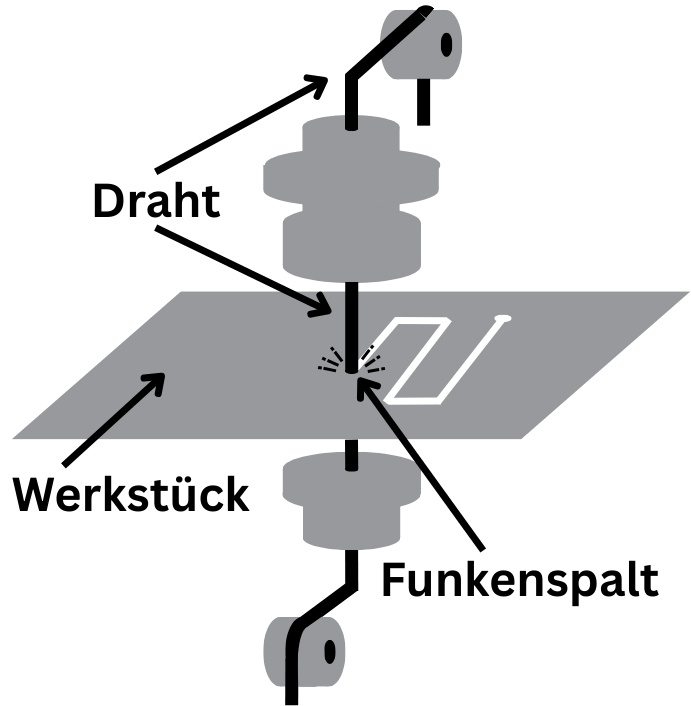
Wire EDM is a process in which metal parts are not machined mechanically, but eroded contact-free by electrical discharges. A very fine, electrically charged wire, sometimes thinner than a human hair, follows the programmed 2D contour. An electric discharge occurs between the wire and the workpiece, which vaporizes the material with pinpoint accuracy. The result: highly precise and extremely fine surface finishes, regardless of how hard or delicate the part is.
The wire moves through a dielectric fluid(usually deionized water), which insulates the discharges and simultaneously cleans and cools the cutting zone. Thousands of small discharges per second remove the material point by point, without any mechanical pressure, which prevents any mechanical distortion of the workpiece. The process is particularly suitable for hard, conductive materials such as tool steel, hard metal (carbide), medical-grade stainless steel, or titanium. The non-contact process makes Wire EDM ideal for precise shapes and micro dies with intricate internal contours.
Each discharge generates temperatures of up to 12,000 °C, which directly vaporizes the material. The resulting heat-affected zone is extremely thin (<10 µm) and shows minimal thermal impact. In contrast to milling or lasering, Wire EDM does not cause surface hardening or internal stress in the material. In addition, Wire EDM using wire diameters from 0.15 mm allows internal radii as small as 0.08 mm to be cut (with Fine Wire EDM even internal radii of 0.015–0.02 mm can be achieved). This would be impossible with conventional machining. Tapered cuts can also be realized.
Technical details for wire EDM
- Tolerances: down to ± 0.0015 mm
- Surface roughness: down to Ra 0.08 (in deionized water) or Ra 0.06 (in oil) / N2-N3
- Internal radii: down to 0.08 mm (0.015 - 0.02 mm with fine wire EDM)
- Tapered cuts: CNC-controlled up to ±30°
- Wire diameter: from 0.15 mm to 0.3 mm (0.02 mm with fine wire EDM)
- Micro holes: smaller than Ø 0.01 mm - 1.5 to 2 mm deep.
- Dielectric: deionized water or oil bath, ideal for corrosion-sensitive materials
- Production capacities: single-piece, prototype and series production available
- Wire EDM requires electrically conductive materials
Materials suitable for Wire EDM
- Medical-grade stainless steels AISI 304 (V2A), AISI 316L (V4A, highly corrosion-resistant).
- Titanium and titanium alloys
- Carbides (e.g. tungsten carbide)
- High-strength tool and high-speed steels (e.g. HSS, ASP), powder-metallurgical grades
- Stainless steels (INOX), hardened steels up to > 60 HRC
- Aluminum, copper, brass, bronze
- Technical ceramics
- Special alloys: NiTi (Nitinol), Hastelloy

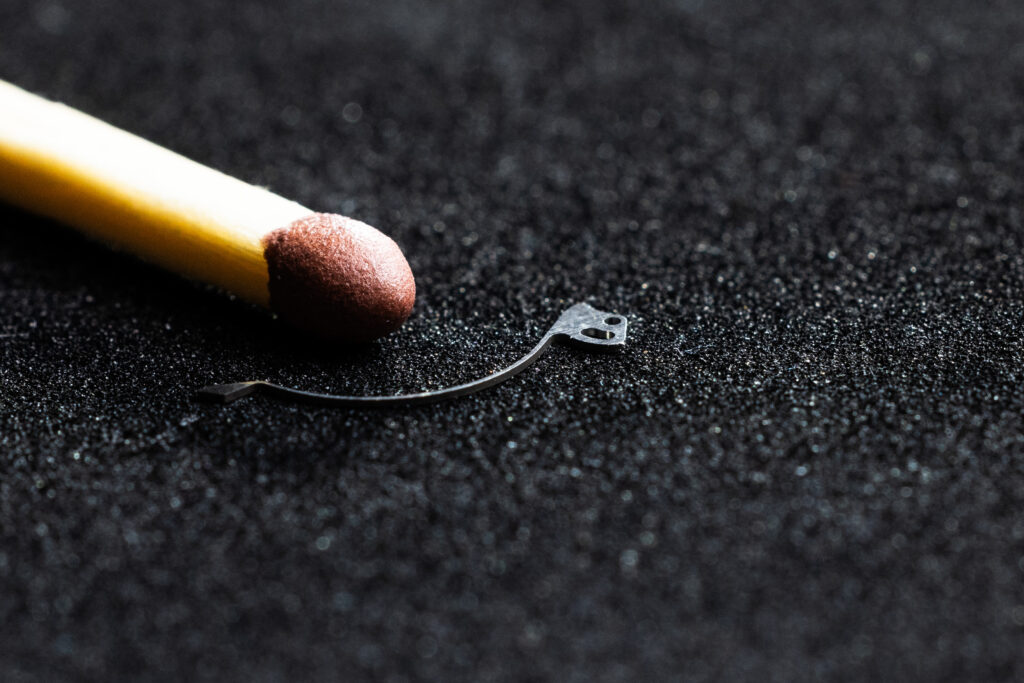
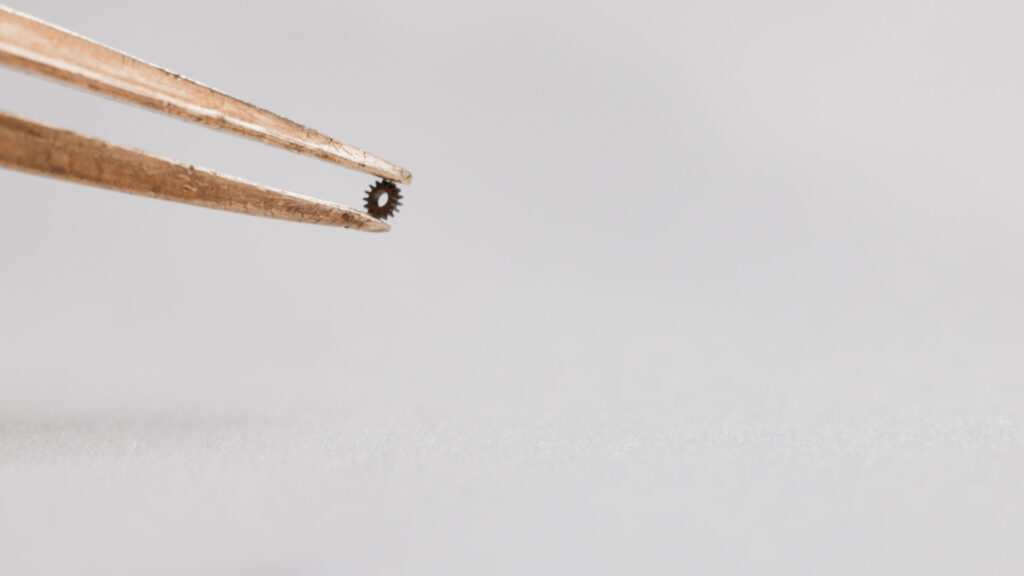
Typical applications of Wire EDM
Tool and mold making:
- Mold inserts, ejector pins, and cores for injection molding tools
- Bending and embossing tools
Mechanical engineering:
- Small precision gears made from hardened materials
Medical technology:
- Fastening elements and functional components
- Measuring gauges made of carbide for implants
General manufacturing:
- Machining of hardened components
- Creation of contours that cannot be produced mechanically
Material testing:
We guarantee the highest accuracy and quality.
Why choose Retero as your partner for Wire EDM machining?
Your idea deserves the highest precision.
When it comes down to microns, every detail counts. As a family-run company, Retero GmbH is your experienced partner for high-precision micromachining. With over 20 years of specialization, a state-of-the-art machine park and Swiss quality, we deliver uncompromising results reliably and personally.
Swiss quality
Retero has been certified to ISO 9001 and ISO 13485 for more than ten years. Two internationally recognized standards that mean measurable safety and trust for our customers.
- ISO 9001 confirms our consistently practiced quality processes in all areas, from production to delivery.
-
ISO 13485 is the gold standard in medical technology and requires:
- complete traceability
- validated processes and suppliers
- strict documentation and uncompromising precision
Our quality assurance goes beyond standards: we embody true Swiss precision, with responsibility, technical excellence, and a clear focus on safety.


What our customers say about us
Trustindex überprüft, ob die Originalquelle der Bewertung Google ist. Eine unkomplizierte Firma mit hohem Fachwissen, die Ihr Handwerk versteht. Nur zu empfehlen, tolle Zusammenarbeit.Gepostet aufTrustindex überprüft, ob die Originalquelle der Bewertung Google ist. Wie pflegen eine langjährige und gute Zusammenarbeit. Der Erodierspezialist schlechthin. spalinger präzisionsmechanik gmbhGepostet aufTrustindex überprüft, ob die Originalquelle der Bewertung Google ist. Microbearbeitungs Profi mit höchster Präzension. Sehr zu empfehlen!Gepostet aufTrustindex überprüft, ob die Originalquelle der Bewertung Google ist. Retero ist in der Mikrobearbeitung wie Feindraht- und Drahterodieren, Präzisionslaserschneiden sowie im Stanz- und Biegewerkzeugbau ein unschlagbar Partner. Die hohen Erwartungen an die Qualität der Werkstücke wird Retero in allen Belangen gerecht.
Questions and answers about wire erosion
Yes, it is possible - if you have the right machines and skills. We have both and are able to erode slots of up to 0.08 mm in diameter in workpieces with erosion wires of just 0.04 mm. Please contact us and we will be happy to provide you with a quote for your project.
Technology in this sector is developing rapidly, and ever smaller wire diameters can be processed. Thanks to ultra-modern high-tech machines and a great deal of know-how on the part of Retero GmbH, we are able to use and process wires with a minimum diameter of 0.02 mm.
Surfaces of Ra 0.08 quality can be achieved on the oil wire erosion machine from Retero GmbH; Ra 0.10 is possible with water bath erosion machines. These values can be achieved without costly and time-consuming post-processing.
Yes, that is possible. At Retero GmbH, we are able to achieve conical shapes of up to 30 degrees. Ask us, we will be happy to advise you and show you what is possible.
Thanks to electrical discharge machining, even extremely hard materials such as titanium, hardened steel, special alloys or conductive high-strength ceramics can be easily processed and shaped into the desired form. Aluminum, copper, graphite, molybdenum, tantalum, tungsten and iridium are common wire erosion materials.
The feed rate for wire EDM can be set by the machine or manually and depends on the maximum output of the generator of the respective wire EDM machine. he roughing cut, for example, is performed at 150 mm²/min to 250 mm²/min and an average reference height of 60 mm.
Wire EDM can be used to create any profile in the form of through holes, even in hardened steel materials or carbide. Even the machining of materials that are difficult to cut is normally not a problem. The process is therefore often used to produce workpieces made of titanium alloys, hard materials or even conductive, high-strength ceramics. Even the production of extremely demanding, complicated internal shapes with the smallest corner radii and simultaneously high dimensional and shape accuracy can be realized with wire erosion. Wire erosion is characterized by uniform surfaces with a high surface quality after production.
Regardless of manufacturer and design, wire erosion machines use a 0.02 to 0.3 mm thick metal wire as a tool (in this case an electrode). This wire, which is usually made of brass but can also be made of tungsten or steel, is unwound from a spool and pulled tightly through the workpiece to be machined with the help of a roller system. Wire guides above and below the component support the brass wire and ensure a straight cut. A starting hole must be drilled before wire cutting can be carried out from closed openings. The brass wire is then threaded through the workpiece into the hole for the actual EDM process. The component, which is fixed on a suitable clamping device, is then spark eroded in a dielectric. For this purpose, the clamping devices must be set up in such a way that collision-free erosion can take place in the entire machining area.
Wire EDM can achieve surface qualities of up to Ra 0.1 and tolerances of +/- 0.0015 mm. Radii of up to 0.009 mm and conical shapes up to a height of 100 mm are also possible. The wire diameter of 0.15 to 0.30 mm enables efficient and precise cutting.
In the medical sector, wire erosion is often used for the production of endoscopes and other small medical parts made from conductive materials such as stainless steel. Precise spark erosion enables the production of complex shapes and thin walls without damaging the material. This enables the production of high-quality medical devices that meet the highest requirements.
