
Laserschneiden Toleranzen und Genauigkeit

Technical tolerances at a glance for decision-makers and developers

If you are planning with tolerances in the range of ±0.01 mm, you know that there is often a world of difference between technical feasibility and actual implementation. Particularly in medical technology, micromechanics or semiconductor technology, the exact cutting quality can be decisive for the functionality or approval of a component. But what is really feasible with laser cutting? And where does the process reach its physical or process-related limits?

This technical article provides you with a sound overview of tolerances, cutting quality and repeatability. You will learn which technical parameters influence accuracy, why the choice of material plays a key role and how component geometry, software control and data preparation affect the result. We also compare laser cutting with alternative processes such as wire erosion or milling – objectively and application-oriented.

By the end of this article, you will not only know how precise laser cutting actually is. You will also recognize how you can implement high-precision components economically with the right partner – reliably, repeatably and documented on request. A benefit for every demanding application.

Table of contents

What influences the accuracy of laser cutting?

Material thickness, material type and their role

The choice of material plays a decisive role in the precision that can be achieved during laser cutting. Materials such as stainless steel, aluminum, carbide or ceramic react differently to the laser beam, as they differ in terms of reflection, thermal conductivity and melting behavior. While aluminum shows a stronger expansion due to its high thermal conductivity, ceramic remains sharper in the contour, but requires a precise energy supply.

As the material thickness increases, the behavior of the cut also changes. Thin sheets of less than 1.5 mm can be processed with a tolerance of ±0.01 mm. With thicker materials – up to 3.0 mm – larger deviations are to be expected. Here, a tolerance range of ±0.03 mm is often realistically planned. In practice, this means that the thicker the material, the more the cutting strategy must be adapted in order to minimize thermal deformation and dimensional deviations.

Different materials for laser cutting with reference to reflection and thermal behavior.

Machine precision and drive technology

The mechanical precision of the laser cutting system used is a key factor. The accuracy of the XY axes, the stability of the laser head and the tension of the belt drives determine how clean and repeatable a cut can be. Even small clearances or vibrations can cause contours to be blurred or out of round – especially with small geometries.

The control technology is just as relevant. If the cutting path is precisely coordinated with the CAD drawing using CNC-controlled systems, the positioning accuracy can be significantly increased. Errors in data transfer or poorly configured machine parameters, on the other hand, have a direct impact on the dimensional accuracy of the components.

The Kerf effect – when the kerf becomes a tolerance trap

Each laser cut creates a kerf, also known as a kerf. This varies depending on the material, focus point and power – typically in the range of 0.05 mm to 0.15 mm. The problem is that if the kerf is not taken into account, dimensional deviations can occur in tightly toleranced components, for example in drill holes or narrow cut-outs.

Precise control of the kerf requires not only fine tuning of the laser power and speed, but also continuous quality control. If the process parameters are properly documented and kept stable, the kerf width can be kept constant – a decisive advantage for series production and ISO-compliant manufacturing.

Cutting speed and energy input

Cutting faster does not automatically mean working more precisely. On the contrary: high cutting speeds can lead to burr formation, rounded edges and irregular contours. Particularly with fine geometries or tight radii, it makes sense to work at a reduced speed and with a focused energy input.

The art lies in the balanced interplay of feed speed, laser power and focus position. A good machine automatically recognizes when it needs to slow down – provided the parameters have been set intelligently. The aim is to keep the heat input low and still guarantee consistent cutting quality. This results in a clean cut – without distortion, without overheating and with consistently high precision.

Technical specifications for laser cutting – what is really possible?

Typical tolerances for precision laser cutting

In industrial laser cutting, tolerances are defined limits rather than guidelines. In practice, this means that for sheet metal with a thickness of less than 1.5 mm, the achievable tolerance is ±0.01 mm. This accuracy is particularly relevant for delicate components, where any dimensional deviation can have functional consequences.

When working with thicker materials – up to 3.0 mm, for example – the tolerance ranges shift towards ±0.03 mm. The decisive factor here is not only the material thickness, but also the thermal stability during the cut. Thanks to precise laser settings and intelligent cutting guidance, impressive dimensional accuracy can be achieved even with thicker materials.

Surface quality and contour accuracy

In addition to the tolerance, the surface quality also determines how functional and processable a component is. With modern systems, Ra values of up to 0.80 can be achieved – this corresponds to class N6 and can be used without additional post-processing. The cut edges appear visually clean, are free of oxide layers and do not exhibit any thermally induced deformations.

A common problem with laser cutting is burr formation, especially with high-alloy steels or poorly degassed material. However, this problem can be almost completely eliminated through a combination of the right choice of gas (e.g. nitrogen instead of oxygen), optimized focus position and controlled feed speed. The result: smooth edges, no sharp transitions and high contour accuracy even with small radii.
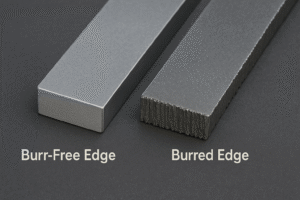
Comparison between burr-free and burred laser cut edges.

Repeat accuracy for series production

Precise individual part production is one thing. Repeatable quality across a complete series is a much greater challenge. This is where standard technology separates itself from true precision technology. High-quality laser cutting systems achieve a repeat accuracy of a few micrometers under constant conditions – even for batch sizes of up to 1000 pieces.

This consistency is crucial for many industries. Particularly in medical technology or semiconductor manufacturing, strict standards apply, for example within the framework of ISO 13485, where every cut, every contour and every dimension must be documentable and reliably reproducible. This is the only way to develop products that can survive in regulatory markets – both technically and formally.

Laser cutting vs. other processes in an accuracy comparison

Punching and milling in comparison

When choosing the right manufacturing process, it is not only the speed that counts, but above all the achievable dimensional accuracy. Although punching is economical for large quantities, it quickly reaches its limits with complex geometries or intricate contours. The tool-related tolerance is typically ±0.1 mm or higher, depending on the wear condition of the tool.

Another disadvantage is that the mechanical pressure during punching causes deformations at the edges. These often have to be compensated for by post-processing. Burr formation is also a well-known phenomenon that cannot be completely avoided, especially with hard materials.

Better tolerances can be achieved when milling, especially if CNC-controlled machines with high-quality tools are used. Nevertheless, a certain amount of tool wear is inevitable. The diameter changes minimally with each revolution – and with it the result on the component. In addition, milling is often not the first choice for thin sheet metal, as vibrations and material deflection can have a negative impact on the cutting quality.

Wire EDM and micromachining as alternatives

When maximum precision is required for extremely fine structures, wire erosion is wear-freeand achieves tolerances of up to ±2 µm. Erosion offers clear advantages, particularly with hard metals or ceramics, because there are no mechanical forces acting on the workpiece. This enables distortion-free machining even with the smallest geometries.

However, wire erosion is significantly more time-consuming than laser cutting. The material is not removed thermally, but by controlled spark erosion – which slows down the process. In series production, this can quickly become a bottleneck, especially for complex shapes with many individual contours.

This is why specialized providers such as Retero rely on combination processes. Where the laser reaches its limits, electrical discharge machining takes over specific individual areas. In this way, highly complex components can be produced where fine cutting, burr-free edges and tight tolerances are required. This hybrid approach combines the best of both worlds – and creates solutions where pure processes fail.

Tolerances in comparison

Procedure Tolerance range Burr-free Reworking
Laser cutting ±0.01 - 0.03 mm High Usually not necessary
Punching ≥ ±0.10 mm Low Yes
Milling ±0.05 mm Medium Partial
Wire EDM ±0.002 mm Very high No

Laser cutting combines high precision with efficiency - ideal for complex structures.

Influence of geometry, component design and software

Tight radii, drill holes, narrow contours

The geometry of a component determines how precisely it can be produced with the laser. Particularly with tight radii, micro bores or narrow passages, the interplay of focus position, beam shape and feed rate is decisive for success. The smaller the radius, the more precisely the laser beam must be controlled – radii of up to 0.05 mm are technically feasible, but only with optimum machine calibration and suitable material selection.

A common mistake in the design is neglecting the cutting width and minimum web width. If, for example, a web is planned too narrow, the laser can thermally overload the area or even completely dissolve it. It is therefore worth making production-oriented adjustments during the design phase. This allows contours to be realized that are both precise and economical.

CAD data, conversion and machine language

What looks perfect in the design software may look completely different on the machine. A frequent stumbling block is the definition of units: If a model is created in inches and exported as a millimeter file – or vice versa – there are often massive deviations that only become noticeable after cutting.

Equally critical are faulty layers, unclosed contours or double lines in the CAD drawing. These are not recognized by the control system as visual problems, but lead to faults in the cutting path. This results in uncleanliness, positioning errors or even machine stops.

Proper digital pre-processing is therefore essential. This not only includes correct scaling, but also checking the data for technical feasibility. Modern CAM systems offer automated checking mechanisms for this – but it is still important that design and production work closely together. This is the only way to ensure precise and reproducible results.
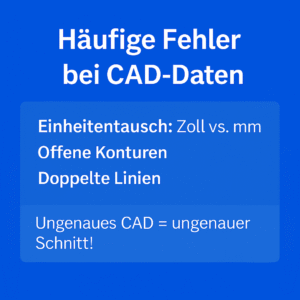
Common errors in CAD data

Practical examples: When every micrometer counts

Microimplants and surgical instruments

In medical technology, the smallest error can often make the difference between approval and recall. Microimplants and minimally invasive instruments must not only be biocompatible, but also have absolutely burr-free cutting edges and an exact fit. The requirements for dimensional accuracy are in the range of a few hundredths of a millimeter – with simultaneous documentation requirements in accordance with ISO 13485.

A concrete example: laser-cut endoscope components made of stainless steel. Here, it is not only the precise contour that is important, but also the reproducibility of every hole in series production. Thanks to optimum cutting parameters and material-friendly processing, functional components with smooth inner edges, sharp detail contours and uniform cutting quality are produced – even in batches of less than 500 pieces.

Watch components with the highest requirements

In watchmaking, it is not only function that counts, but also appearance. In this environment, Swiss Made does not simply mean origin, but absolute precision in the tightest of spaces. Especially for components such as springs, retaining plates or dial details, the combination of aesthetic contour fidelity and actual dimensional accuracy is crucial.

The production of these parts requires precise cutting lines with minimal distortion and zero burr formation. To achieve this, Retero combines high-resolution laser systems with finely tuned process parameters. The result: complex micro-components that are impressive both under a magnifying glass and a measuring microscope.

Semiconductor technology & piezo systems

In the world of microsensors and semiconductor technology, the tolerance specifications are in an area where standard processes have long since failed. Structures below 0.1 mm, insulated webs, narrow passages – all this must not only be possible, but also feasible in series production.

For piezo systems in particular, which rely on precise mechanical reactions, every edge counts. Retero enables precision suitable for series production through laser-based production with continuous quality control. The manufactured parts are characterized by homogeneous edge patterns, exact dimensional control and process-reliable repeatability – even with critical geometries.

These examples show: When micrometers are not a theoretical quantity, but a living standard, not only good technology is required, but also a deep understanding of the requirements of the respective industry.

Questions, myths and real restrictions

“Laser is not precise enough for my application”

This statement is often made – usually based on previous experience with outdated technology or poorly adjusted machines. In reality, modern systems offer cutting precision in the range of ±0.01 mm with high repeatability. The decisive question is therefore not whether the laser is precise enough in principle, but under which conditions the desired accuracy is achieved.

The quality of the machine, the expertise in setting up the parameters and the choice of material have a greater influence on the result than the process itself. If you work with high-resolution optics, stable axis mechanics and cleanly prepared data, you can achieve tolerances with laser cutting that were previously reserved for mechanical processes.

“What happens with thick materials?”

A common objection concerns the accuracy of thicker material. In fact, the risk of thermally induced deformations increases with increasing thickness. From a material thickness of around 2.5 mm, tolerances of ±0.01 mm are no longer realistic across the board, especially with thermally conductive metals such as copper or aluminum.

But there are solutions here too. Process stability can be significantly increased with an adapted reduction in cutting speed, tight focus control and the use of suitable gases. For particularly demanding components, a combination of laser cutting and subsequent erosion can be used in a targeted manner to rework critical areas – without stressing the entire component.

“How can I have the feasibility checked in advance?”

For new projects in particular, it is worth carrying out a tolerance check before production begins. This involves analyzing the design data, comparing the planned dimensions with the technical possibilities and identifying potential problem areas.

In addition, modern software can be used to create a realistic simulation of the laser cut. This allows developers to see in advance where thermal loads could occur or geometries could become critical. Using this potential not only saves time during implementation, but also avoids expensive iterations in subsequent production.

With a systematic approach, feasibility, tolerance reliability and production costs can be precisely assessed as early as the design phase.

When precision is not an option, but a prerequisite

Production of high-precision microcomponents at Retero in Switzerland.

Wherever high cutting quality, stable processes and documented tolerances are a basic requirement – for example in medical technology, sensor technology or micro-optics – it is not enough to simply cut a component. What is needed is a production facility that fully understands and can implement the technical requirements. Not theoretically, but practically – repeatably and verifiably.

Retero meets precisely this requirement. As a specialist in precision laser cutting, the focus is on processing sheet thicknesses between 0.02 mm and 3.0 mm, with tolerances of up to ±0.01 mm. This accuracy is not a special case, but an integral part of the series processes.

Whether small series, functional prototype or one-off production – all steps are designed for reproducibility, quality and material expertise. The advantages of the laser and control technologies used are particularly evident when working with challenging materials such as ceramics, titanium or carbide.

If you not only want precise, but also process-oriented manufacturing, Retero is a partner that combines technical understanding with entrepreneurial reliability. We are happy to check your CAD data for feasibility or provide you with our tolerance data sheet – so that an idea becomes a realizable component.

Do you need precise laser cuts with documented tolerances?

We cut with ±0.01 mm accuracy - reproducible, clean and suitable for series production

Conclusion: Laser cutting and accuracy – what you should take with you

Anyone who thinks that laser cutting is just a quick way to cut to size is misjudging the enormous potential of modern precision technologies. With the right machine setup, a well-thought-out choice of material and a production-oriented design, tolerances in the range of ±0.01 mm can be reliably achieved today – even in series production.

A decisive factor is the combination of process understanding, machine technology and data preparation. Every geometry has different requirements and every material reacts differently to heat, speed and gas supply. Only those who master these parameters can achieve results that are not only precise, but also economically viable.

In direct comparison to other processes, laser cutting is particularly impressive for complex structures, narrow webs and intricate cut-outs. The non-contact process prevents mechanical deformation, reduces the amount of reworking required and also offers high process stability.

When maximum precision is not optional, but necessary, you need not only a good machine, but also a partner who understands and masters the entire process. Retero is precisely this partner – a company that combines technology, experience and precision. And that makes every cut a reliable solution.

Frequently asked questions (FAQs) about laser cutting tolerances

How much tolerance for lasering?

With precision laser cutting, tolerances of ±0.01 mm are possible for thin materials up to 1.5 mm. For material thicknesses up to 3.0 mm, the typical tolerance is ±0.03 mm.
With modern laser cutting systems, dimensional accuracies in the hundredths of a millimeter range can be achieved – depending on the material, thickness and machine settings.
High-quality machines achieve a machining accuracy of up to ±0.01 mm. The repeat accuracy is usually in the range of a few micrometers, provided that all process parameters are set optimally.
Materials with chlorine-containing additives such as PVC or Teflon must not be lasered as they release toxic gases. Fiber composites with epoxy resins are also critical.
The thinner the material, the more precisely it can be cut. Thin sheets of less than 1.5 mm provide the best tolerance values.
Yes, especially for small to medium batch sizes, laser cutting is highly reproducible and economical – even with tight tolerances.
Yes, even the smallest radii, fine webs and filigree contours can be realized precisely with the right machine configuration and experience.